Industrial Tray Washer Guide | Choosing the Right Tray Washer
Choosing the right industrial tray washer can make a major difference to hygiene, labour efficiency, water use and production flow. Whether you are washing trays, crates, Euro containers or other reusable load carriers, the right system needs to suit your contamination level, throughput and available space.
This guide explains what an industrial tray washer does, what to consider before buying one, and how to compare compact, medium-capacity and higher-throughput tray washing systems for food production environments.
You can view our tray washing systems here.
What Is an Industrial Tray Washer?
An industrial tray washer is an automatic washing machine designed to clean trays and other reusable containers used in food processing and handling. Depending on the application, these machines may also be used for crates, boxes, totes and Euro containers where repeatable hygiene standards and reliable wash performance are required.
In practice, a tray washing system helps to:
- Improve hygiene consistency
- Reduce manual cleaning time
- Support food safety procedures
- Increase tray turnaround
- Reduce bottlenecks in production
Why Tray Washing Systems Matter
Better Hygiene Control
Reusable trays and containers move between multiple areas of a site. A well-matched washing system helps remove contamination more consistently than manual cleaning alone.
Improved Workflow
Automated washing helps trays return to service faster, especially in high-volume food production where handling time and line flow matter.
More Efficient Use of Labour and Utilities
A properly specified machine can reduce manual handling and help control water, energy and chemical use while still delivering reliable results.
What to Consider Before Buying
The best machine is not simply the biggest one. It needs to match what you are washing, how dirty it is, how many items you need to process per hour, and how the machine fits into the rest of your layout.
Contamination Type
Proteins, blood, fats, glue residue and dried-on dirt all wash differently. That affects wash time, temperature, chemistry and mechanical action.
Hourly Throughput
Think in trays or containers per hour, especially at peak times. That usually matters more than average daily volume.
Tray Size and Format
Tray width, tray height and the type of load carrier all matter. The machine needs to suit what is actually used on site.
Process Fit
Consider loading, unloading, one-person operation, conveyor integration, available labour and how washed trays return into the process.
Elpress’s guidance on what to consider when buying a crate washer is a useful reference point when planning the right system.
What Affects Wash Performance?
Wash performance is usually a balance between mechanical force, time, temperature and chemistry. If one factor is limited, another usually has to increase. For example, where floor space is tight and the machine cannot be very long, soak time and wash time may be restricted, which can mean more emphasis on temperature, chemical support or mechanical action.
This is especially important when contamination varies. Proteins and blood residues usually need lower temperatures and enough soaking time, while fats often respond better at higher temperatures. Dried-on contamination and adhesive residue can also need a different approach.
From Compact Machines to High-Capacity Inline Systems
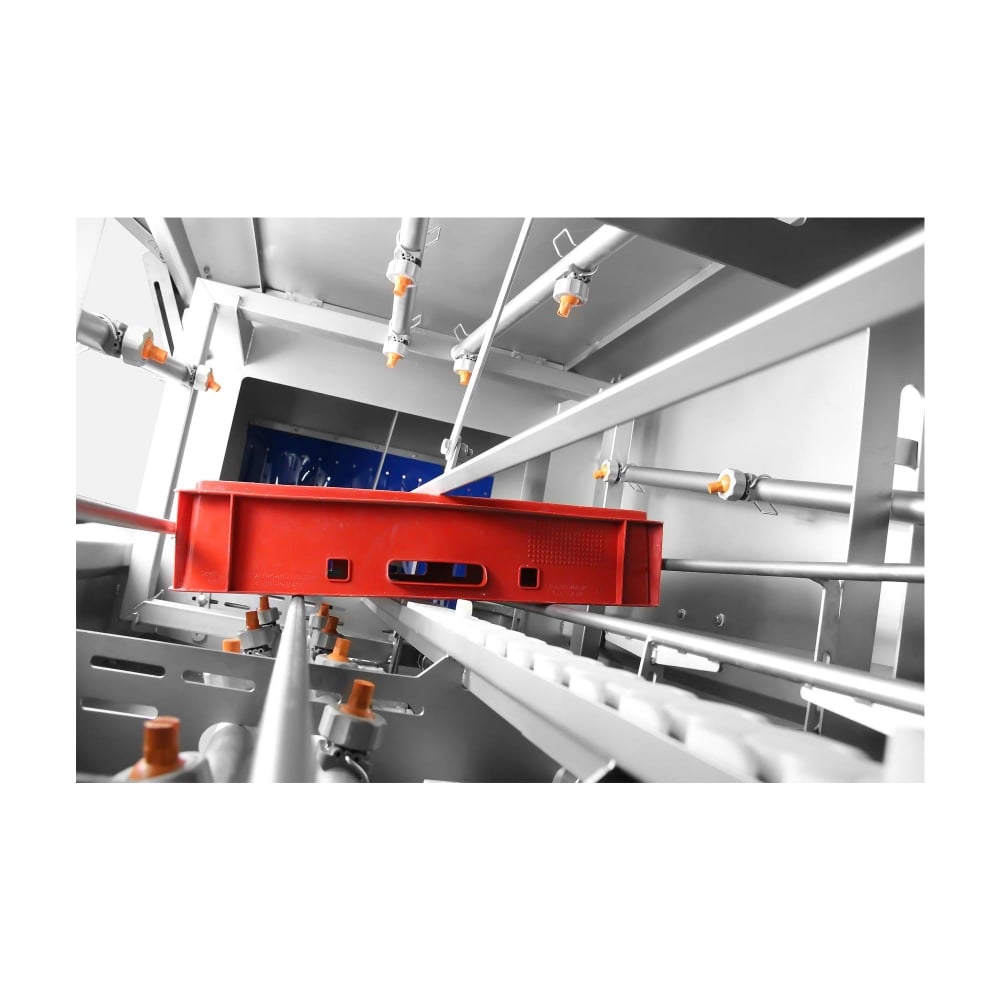
The right choice depends on the scale of your operation. Some businesses need a compact, single-lane system, while others need a larger inline tray washer with multi-stage washing and options for continuous production.
Compact and Medium-Capacity Machines
Smaller and mid-range machines can be a good fit where throughput is moderate, space is tighter, or where a one-person operation is preferred. They often suit sites looking for reliable washing performance without moving straight to a full inline solution.
See examples in our range such as the Elpress EKW1500 tray washer and the Elpress EKW2500 tray washer.
Higher-Throughput and Inline Systems
Larger sites may need higher-capacity systems that can support continuous production, more trays per hour, extra rinse stages, drying options, filtration upgrades, or smoother integration into existing handling lines.
Our broader range includes larger options and custom tray washing solutions for sites that need more than a compact machine. You can browse the full tray washer range here.
Tailored Systems for Specific Workflows
The best result often comes from matching the machine to your trays, contamination level, staff flow and layout. On some sites, manual loading is perfectly adequate. On others, one-person operation, input and output tables, or wider line integration make much more sense.
See a tray washing system in operation:
What to Check Before Installation
Site and Access
- Enough room to get the machine into place
- Sufficient space around the washer for access and cleaning
- A floor strong enough to support the equipment
- Good tray flow in and out of the machine
Utilities and Environment
- Power supply available
- Water supply available
- Drainage in the right location
- Heating provision for wash water where required
- Cleaning access around the machine
- Vapour extraction if needed
Elpress’s article on installing a crate washer gives a useful checklist for space, floor strength, power, water and drainage.
Why a Tailored Specification Matters
Tray washers should be selected around the requirements of the individual business. Capacity, contamination type, loading method, wash stages, layout and available options all affect whether the machine becomes an efficient part of production.
A system that is too small can create a bottleneck. A system that is larger or more complex than required can add unnecessary cost and take up valuable floor space. The best result normally comes from matching the washer to the actual process rather than buying on headline capacity alone.
Need Help Choosing the Right Tray Washing System?
We supply tray washers for food factories, processors and other hygiene-critical environments. If you need help comparing machine sizes, layout options or throughput requirements, get in touch.
Frequently Asked Questions
What does a tray washing machine clean?
These machines are typically used to clean trays, crates, Euro containers, boxes and other reusable load carriers used in food production.
How do I choose the right machine for my site?
Start with contamination type, trays per hour, tray size, available space, utilities and how the machine will fit into your wider production process.
Are larger inline systems always the best option?
Not always. A larger system can be right for high-volume sites, but smaller or medium-capacity machines may be a better fit where space, labour or throughput requirements are different.
What utilities are needed?
Most sites need suitable power, water supply, drainage, adequate access and enough surrounding space for operation, cleaning and maintenance.
Can a tray washer be tailored to a specific process?
Yes. Capacity, loading method, wash stages, options and layout should be matched to the trays used, the level of contamination and the way the production area operates.
Conclusion
The right tray washing system is the one that matches your trays, contamination level, throughput and available space. Getting that specification right helps improve hygiene, supports efficiency and makes the machine a practical part of your process rather than just another piece of equipment.
If you are comparing options now, start with the wash requirement, the layout and the level of throughput you need, then work back to the machine size and features that fit your site best.